





Electric Cars: The Basics
For those of you new to zero-emission electric driving, we recommend a read of the following articles:
Different Type Of Electric Vehicles (EVs): The Complete Electric Car Buying Guide For Ireland
Electric Cars: The Basics For those of you new to zero-emission electric driving, we recommend a read of the following articles: Sign up to the e-zoomed Electric Living newsletter…
Read More
Benefits Of Electric Driving: The Complete Electric Car Buying Guide For Ireland
Electric Cars: The Basics For those of you new to zero-emission electric driving, we recommend a read of the following articles: Sign up to the e-zoomed Electric Living newsletter…
Read More
What Is Regenerative Braking: The Complete Electric Car Buying Guide For Ireland
Electric Cars: The Basics For those of you new to zero-emission electric driving, we recommend a read of the following articles: Sign up to the e-zoomed Electric Living newsletter…
Read More
Benefits Of Green Energy: A Guide For Ireland
Electric Cars: The Basics For those of you new to zero-emission electric driving, we recommend a read of the following articles: Sign up to the e-zoomed Electric Living newsletter…
Read More
EV Charging Cables: The Complete Electric Car Buying Guide For Ireland
Electric Cars: The Basics For those of you new to zero-emission electric driving, we recommend a read of the following articles: Sign up to the e-zoomed Electric Living newsletter…
Read More
How Much Does It Cost To Charge An Electric Car At Home: The Complete Electric Car Buying Guide For Ireland
Electric Cars: The Basics For those of you new to zero-emission electric driving, we recommend a read of the following articles: Sign up to the e-zoomed Electric Living newsletter…
Read MoreSign up to the e-zoomed Electric Living newsletter
The All-Electric Ford Capri SUV
Ford is the second-largest automotive manufacturer in the United States, and in the top 10 globally. The company is largely owned by institutional investors (60%). However, the Executive Chairman of the Ford board is William Clay Ford Jr., the great-grandson of Henry Ford. The company has operations globally, to include: United States, Canada, Mexico, China, India, the United Kingdom, Germany, Turkey, Brazil, Argentina, Australia, and South Africa. As of 2023, the company sold over 4.4 million cars worldwide.
The Ford electric vehicle (EV) portfolio includes both, battery-electric vehicle (BEV) and plug-in hybrid electric vehicle (PHEV) models:
- All-electric Ford Capri (BEV)
- All-electric Ford Mustang Mach-E (BEV)
- All-electric Ford Explorer (BEV)
- Ford Kuga Plug-in Hybrid (BEV)
The Ford Capri model name will be familiar to many. The conventional internal combustion engine (ICE) Ford Capri fastback coupé was launched in 1968 in Europe, to offer a Ford Mustang equivalent. Not surprisingly, the designer for the Ford Capri had also been involved with the design of the Ford Mustang. Like the Mustang, the Capri too became a very successful model for Ford, selling over 1.9 million units. The Capri name was inspired by the famed Italian island with the same name! The Ford Capri internal combustion engine (ICE) variant ended production in 1986.
Speculation on the revival of the ‘Capri legend’ as a battery-electric vehicle (BEV) started in 2023, with the all-electric Ford Capri crossover coupé/ SUV (C-Segment) being launched in July 2024. Ford describes the Capri EV as ‘Iconic sports car soul with practical SUV functionality’. For those loyal to the two-door low coupé body style of the conventional nameplate, embracing the morphed family coupé-SUV may not be easy to embrace.
One may find some commonality between the exterior stying of the all-electric Ford Explorer and the all-electric Ford Capri, however, the Capri EV is sportier in appearance, enhanced by its coupé silhouette. Both pure electric SUVs use the same platform (and underpinnings) i.e. the Volkswagen Group’s MEB modular platform, also used by Audi, Cupra, Skoda and of course, the VW ID.Family of electric vehicles (EVs). As an example, the all-electric Volkswagen ID.5 uses the MEB platform. Like the Explorer EV, the Capri EV is also manufactured in Cologne, Germany.
The Ford Capri electric car is available in three EV battery sizes. An entry-level 55 kWh (Standard Range), 82 kWh (Extended Range) and 84 kWh (Extended Range). The 55 kWh will be available from late 2024. We would encourage consumers to deliberate carefully their actual real-world driving needs.
Though having a larger EV battery will give more electric range, in reality, most day-to-day commutes are short distances. If you intend to drive long-distances on a regular basis, then opt for the either the 82 kWh or 84 kWh EV battery option. Otherwise the 55 kWh should do just fine!
Apart from a lower price tag, an EV with a smaller battery will have a lower life-cycle emissions footprint, compared to an EV with a larger battery. It is worth noting that apart from the fantastic benefit of zero-tailpipe emissions, pure electric cars also have lower life-cycle emissions compared to conventional petrol and diesel internal combustion engine (ICE) vehicles. Bottom-line, BEVs are far more environmentally-friendly than internal combustion engine (ICE) vehicles.
The Ford Capri is available as both a rear-wheel drive (RWD) and an all-wheel drive (AWD). The AWD variant is only available with the larger EV battery size (84 kWh), with a claimed WLTP range up to 592 km. Adjusting for real-world driving conditions, expect the EV to deliver up to 505 km on a single-charge.
The Capri AWD has DC charging up to 185 kW DC and can be charged up to 80% in 26 minutes. For those new the electric driving, DC EV charging times are usually published up to 80%, as the remaining 20% takes longer to charge. The reason for this is related to the battery management system (BMS) and the long-term health of the EV battery. Of course, it is safe to charge your EV all the way to 100%.
The rear-wheel drive (RWD) 82 kWh has a claimed zero-tailpipe emission electric range up to 627 km (WLTP) on a full charge. Real-world e-range will be closer to 535 km. To further enhance the efficiency (range) of the EV, the manufacturer offers a heat pump, but not as standard. The RWD offers DC charging up to 135 kW DC (10%-80%: 28 mins). It is worth noting that the latest-generation of electric cars offer a faster rapid charging/ ultra-rapid charging DC capability. As an example the all-electric Genesis GV60 SUV offers up to 350 kW DC as standard.
For home charging, used over 80% of the time to charge an EV, we recommend the use of a smart EV charger that is compatible with solar and battery storage. The benefits are significant, to include, saving money and achieving ‘well-to-wheel’ zero-tailpipe emissions. At e-zoomed we offer very attractive bundle offers on home solar PV systems, residential battery storage and smart electric car chargers. The Capri EV has a three-phase (11 kW) AC onboard charger as standard. Only homes with 3-phase power supply can take advantage of the 11 kW AC onboard charging capability.
Ford offers a host of Driver Assist technology as standard. These include: blind spot information system, clear exit warning, cross traffic alert, driver alert, evasive steering assist, lane departure warning, lane-keeping aid, pre-collision assist, rear-view camera, 12 ultrasonic sensors, 5 cameras, 3 radars and more! Also on offer is the Driver Assist Pack as an option. All variants include a 14.6″ SYNC Move touchscreen and full digital cluster screen 5.3″, Android Auto and Apple CarPlay, wireless device charger and pre-conditioning (battery and cabin) as standard.
In terms of practicality, like the Explorer EV, the five-door five-seat Capri EV does not have a frunk. However, it offers a decent boot space (572 L). In comparison, the Explorer electric offers up to 470 L boot space and the ID.5 offers up to 549 L. Like the Explorer, the Capri also has a 17-litre MegaConsole beneath the front armrest (perfect for storing valuables!). In terms of dimensions, both, the Capri & the Explorer have the same wheelbase (2.76m), however, the Capri EV is shorter in length (4.63m) compared to the Explorer EV (4.46m).
The Capri EV has a 1.62m height compared to 1.63m for the Explorer EV. In comparison, the VW ID.5 is 4.59m in length and 1.61m in height, the all-electric BMW iX2 is 4.55m in length and 1.56m in height! The Capri offers decent legroom, and the flat floor of the EV does help those seated in the rear! A coupé roofline does impact the height and available headroom of a vehicle, though to a lesser extent for the Capri.
The 82 kWh rear-wheel drive (RWD) variant can achieve 0-100 km/h in 6.4 seconds (maximum power: 286 PS/ torque: 545 Nm). While the 84 kWh all-wheel drive (AWD) variant can achieve 0-100 km/h in 5.3 seconds (maximum power: 340 PS/ torque: 679 Nm). The top speed of the electric vehicle (EV) is 180 km/h. Like other electric cars, the Capri crossover electric also benefits from the availability of instant torque.
Bottom-line, electric driving is good for the environment and the wallet. It can also be exhilarating!
| PROS | CONS |
|---|---|
| Available in multiple EV battery size options with good real-world electric range | Heat pump not standard |
| Available as RWD and AWD | DC charging only up to 185 kW DC |
| Good level of technology | No frunk |
Gallery


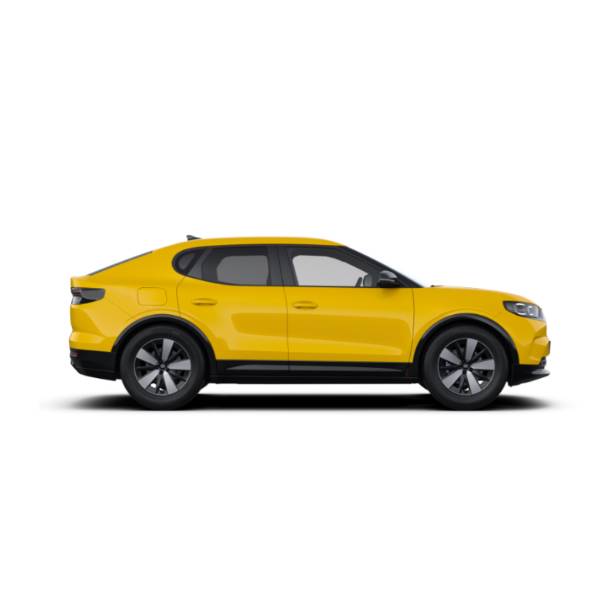
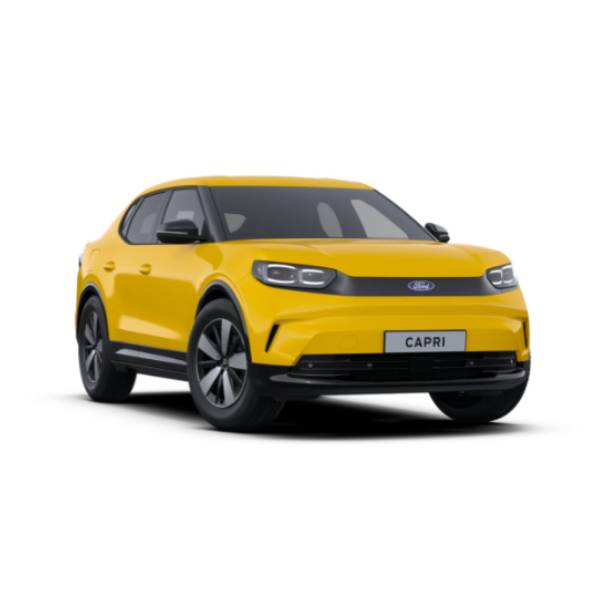
The All-Electric Ford Capri SUV (credit: Ford)
| At A Glance | |
|---|---|
| EV Type: | Battery-Electric Vehicle (BEV) |
| Vehicle Type: | SUV |
| Engine: | Electric |
| Available In Ireland: | Yes |
| € Variants (2 Options) |
|---|
| Ford Capri Select (from € 47.270) |
| Ford Capri Premium (from € 50.990) |
| EV Battery & Emissions | |
|---|---|
| EV Battery Type: | Lithium-ion |
| EV Battery Capacity: | Available in three battery sizes: 55 kWh/ 82 kWh/ 84 kWh |
| Charging: | 135 – 185 kW DC rapid charging (10%-80%: 26-28 mins). Onboard charger: 11 kW AC |
| Charge Port: | Type 2 |
| EV Cable Type: | Type 2 |
| Tailpipe Emissions: | 0g (CO2/km) |
| Warranty: | 8 years or 160,000 km |
| Average Cost Of Residential Charging | |
|---|---|
| Battery net capacity: 12.4 kWh | € 4.25 |
| Battery net capacity: 16.7 kWh | € 5.73 |
| Battery net capacity: 26.6 kWh | € 9.12 |
| Battery net capacity: 30.0 kWh | € 10.29 |
| Battery net capacity: 39.2 kWh | € 13.44 |
| Battery net capacity: 45.0 kWh | € 15.43 |
| Battery net capacity: 50.0 kWh | € 17.15 |
| Battery net capacity: 64.0 kWh | € 21.95 |
| Battery net capacity: 71.0 kWh | € 24.35 |
| Battery net capacity: 77.0 kWh | € 26.40 |
| Battery net capacity: 90.0 kWh | € 30.86 |
| Battery net capacity: 100.0 kWh | € 34.29 |
| Battery net capacity: 112.0 kWh | € 38.40 |
| Battery net capacity: 120.0 kWh | € 41.15 |
| Battery net capacity: 130.0 kWh | € 44.58 |
- Note 1: The average cost of residential electricity in Ireland varies depending on the region, supplier and type of energy used. An average for Ireland is 34.29 cents/kWh. Best to charge an EV overnight when the rates are the lowest.
- Note 2: Not all EV manufactures make available the data on net EV battery capacity, and in a number of instances the EV battery capacity advertised, does not state if it is gross or net capacity. In general, usable EV battery capacity is between 85% to 95% of the gross available capacity.
| Charging Times (Overview) | |
|---|---|
| Slow charging AC (3 kW – 3.6 kW): | 6 – 12 hours (dependent on size of EV battery & SOC) |
| Fast charging AC (7 kW – 22 kW): | 3 – 8 hours (dependent on size of EV battery & SoC) |
| Rapid charging AC (43 kW): | 0-80%: 20 mins to 60 mins (dependent on size of EV battery & SoC) |
| Rapid charging DC (50 kW+): | 0-80%: 20 mins to 60 mins (dependent on size of EV battery & SoC) |
| Ultra rapid charging DC (150 kW – 350 kW): | 0-80% : 20 mins to 40 mins (dependent on size of EV battery & SoC) |
| Tesla Supercharger DC (120 kW – 350 kW): | 0-80%: up to 25 mins (dependent on size of EV battery & SoC) |
- Note 1: SoC: state of charge
| Dimensions | |
|---|---|
| Height (mm): | 1626 |
| Width (mm): | 1872 |
| Length (mm): | 4634 |
| Wheelbase (mm): | 2767 |
| Turning Circle (m): | 10.8 |
| Boot Space (L): | 572 |
| Frunk (L): | N/A |
| RWD 77kWh Extended Range | |
|---|---|
| EV Battery Capacity: | 82 kWh (77 kWh-usable capacity) |
| Pure Electric Range (WLTP): | 627 km |
| Electric Energy Consumption (kWh/100 km): | 13.3 – 17.2 |
| Charging: | 135 kW DC charging (10%-80%: 28 mins). Onboard charger: 11 kW AC (0%-100%: N/A hrs) |
| Top Speed: | 180 km/h |
| 0-100 km/h: | 6.4 seconds |
| Drive: | Rear-wheel drive (RWD) |
| Electric Motor (kW): | 210 |
| Max Power (PS): | 286 |
| Torque (Nm): | 545 |
| Transmission: | Automatic |
| Seats: | 5 |
| Doors: | 5 |
| Kerb Weight (kg): | 2,098 |
| Towing Capacity (Braked/Unbraked)/ (kg): | 1,000 (12% gradient)/ 750 |
| Colours: | 6 |
| NCAP Safety Rating: | N/A |
| AWD 77kWh Extended Range | |
|---|---|
| EV Battery Capacity: | 84 kWh (79 kWh-usable capacity) |
| Pure Electric Range (WLTP): | 592 km |
| Electric Energy Consumption (kWh/100 km): | 15.9 – 20.0 |
| Charging: | 185 kW DC charging (10%-80%: 26 mins). Onboard charger: 11 kW AC (0%-100%: N/A hrs) |
| Top Speed: | 180 km/h |
| 0-100 km/h: | 5.3 seconds |
| Drive: | All-wheel drive (AWD) |
| Electric Motor (kW): | 250 |
| Max Power (PS): | 340 |
| Torque (Nm): | 679 |
| Transmission: | Automatic |
| Seats: | 5 |
| Doors: | 5 |
| Kerb Weight (kg): | 2,174 |
| Towing Capacity (Braked/Unbraked)/ (kg): | 1,000 (12% gradient)/ 750 |
| Colours: | 6 |
| NCAP Safety Rating: | N/A |
What Is A Heat Pump In Electric Cars?
| EV Heat Pump: The Basics | |
|---|---|
| What is a heat pump in electric cars? | In conventional internal combustion engine (ICE), petrol and diesel vehicles, the energy (waste heat) generated from the engine (powertrain), is captured to re-use for heating the interior cabin of the vehicle. However, in pure electric cars, the heat generated (waste heat) from the electric drive (electric motor, inverter, on-board AC charger) and the onboard high-voltage EV battery is not as much, as the heat generated in conventional cars, and cannot be re-used on its own to provide sufficient cabin heating (electric cars are more efficient than petrol/ diesel cars). Therefore in EVs, the sources for capturing heat, also includes the outside air i.e. it is a multi-source heat pump system. This captured heat is re-used for the onboard EV battery management and also for heating the cabin interior, increasing the electric car efficiency and reducing the need to draw energy from the onboard EV battery. In general, a lithium-ion EV battery is less energy efficient during colder months (similar to the laptop or smartphone battery). |
| How does a heat pump increase electric range in colder winter months? | Electric cars that do not incorporate an onboard heat pump, rely on the energy of the onboard EV battery for heating the interior cabin of the electric car, further impacting the available e-range. In contrast, EVs with a heat pump, do not rely on the onboard EV battery to heat the cabin. Instead, the heat pump sources heat from multiple sources and releases energy-efficient heating into the cabin. Put another way, an electric car with a heat pump does not place any demand on the onboard EV battery for heating the interior cabin. There is ample real-world evidence to prove that electric cars with a heat pump offer longer electric range in winter months, compared to electric cars that do not incorporate a heat pump. The average improvement in range is between 10% to 20%. |
| How does a heat pump work in an electric car? | Step 1: naturally heated antifreeze is channelled into the heat pump evaporator, where the heat is transferred to the coolant circulating in the unit. The evaporator converts the coolant into gas (evaporation). Step 2: the gas is sucked into a compressor to increase the pressure of the gas. When air is compressed it increases its temperature. The gas temperature is increased to 80° C. Step 3: the compressed gas is transferred to a condenser, where the heat is transferred to water in the condenser. Step 4: the heat is then circulated to the interior cabin, while the gas is converted into liquid form, and is transferred back to the heat pump evaporator via an expansion valve. The cycle is then repeated. |
| Is a heat pump used only for heating? | No. A heat pump can also be used for cooling. As an example, the Audi Q7 EV uses the onboard heat pump for heating and cooling. |
| Does a heat pump come as standard in EVs? | Though some manufacturers offer the heat pump as standard, most offer it as an optional extra. We recommend purchasing the option. |
| Can a heat pump be installed in an electric car post delivery? | Usually it is not possible, given the complexity of installing a heat pump. So always order it at the time of purchase. |
| Are all heat pumps in electric cars the same? | No. There is a difference in technology, approach and efficiency achieved for different manufacturers. As an example, Hyundai and Kia claim to have one of the most efficient heat pumps, given the ability of their technology to dynamically choose the most appropriate heat source at a given moment. Hyundai claims the heat pump incorporated in the all-electric Hyundai Kona can improve the winter electric range up to 18%, significantly higher than the average improvement (10%). |
| Are there any other advantages offered by a heat pump in colder months? | Yes, you can pre-heat the electric vehicle (EV) via your mobile app before you commence your journey. This way you can have a toasty warm interior cabin on a cold winter day! |
While e-zoomed uses reasonable efforts to provide accurate and up-to-date information, some of the information provided is gathered from third parties and has not been independently verified by e-zoomed. While the information from the third party sources is believed to be reliable, no warranty, express or implied, is made by e-zoomed regarding the accuracy, adequacy, completeness, legality, reliability or usefulness of any information. This disclaimer applies to both isolated and aggregate uses of this information.
Featured Articles

The All-Electric Ford Explorer (SUV): The Complete Electric Car Buying Guide For Ireland
Electric Cars: The Basics For those of you new to zero-emission electric driving, we recommend a read of the following articles: Sign up to the e-zoomed Electric Living newsletter…
Read More
The All-Electric BMW iX2 (SUV): The Complete Electric Car Buying Guide For Ireland
Electric Cars: The Basics For those of you new to zero-emission electric driving, we recommend a read of the following articles: Sign up to the e-zoomed Electric Living newsletter…
Read More
The All-Electric Volvo EX30 (SUV): The Complete Electric Car Buying Guide For Ireland
Electric Cars: The Basics For those of you new to zero-emission electric driving, we recommend a read of the following articles: Sign up to the e-zoomed Electric Living newsletter…
Read More
Honda e:Ny1 Electric (SUV): The Complete Electric Car Buying Guide For Ireland
Electric Cars: The Basics For those of you new to zero-emission electric driving, we recommend a read of the following articles: Sign up to the e-zoomed Electric Living newsletter…
Read More
The All-Electric Volkswagen ID.5 (SUV): The Complete Electric Car Buying Guide For Ireland
Electric Cars: The Basics For those of you new to zero-emission electric driving, we recommend a read of the following articles: Sign up to the e-zoomed Electric Living newsletter…
Read MoreFeatured Products
-
Best-In-Class Home Solar Bundle Offer (440W Trina Solar 8 Panels + Sungrow Hybrid Inverter 3.0 kW): price includes product supply only – free delivery
Original price was: €3,155.95.€3,075.95Current price is: €3,075.95. (Including VAT)Brand:SungrowTrinaSolarCategory:Solar -
Best-In-Class Home Solar Bundle Offer (440W Trina Solar 8 Panels + Sungrow Battery Storage 6.4 kWh + Sungrow Hybrid Inverter 3.0 kW): price includes product supply only – free delivery
Original price was: €6,115.95.€5,999.95Current price is: €5,999.95. (Including VAT)Brand:SungrowTrinaSolarCategory:Solar -
Bundle Offer: Sungrow Home Battery Storage (6.4 kWh) + Sungrow Hybrid Inverter (5 KW/ Single-Phase): price includes product only – Free delivery
Original price was: €4,549.95.€4,050.95Current price is: €4,050.95. (Including VAT)Brand:SungrowCategory:Battery Storage -
Untethered Ohme Home EV Charger (7kW): price includes product only – free delivery
Original price was: €780.95.€685.95Current price is: €685.95. (Including VAT)Brand:OhmeCategory:EV Charging PointsCable:Untethered -
Custom-Made 1-Phase EV Charging Cable Type 2 to Type 2 (2m to 45m, 7.4 kW) – Made In Europe – Free Delivery
Price range: €219.95 through €645.95 (Including VAT)Category:EV Charging CablesType:Type 2Length (m):5 m10 m6 m15 m20 m2 m25 m30 m35 m40 m45 m3 m7 m8 m12 m18 m22 mCurrent (amp):32 ampPhase:Single Phase (7.4kW)This product has multiple variants. The options may be chosen on the product page


